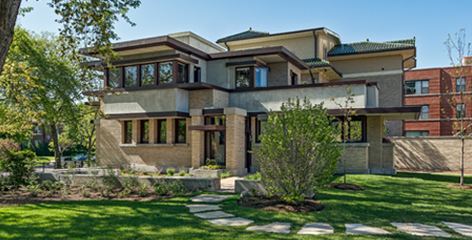
A few of Wright's commercial works included the Unity Temple, The Rookery, and the Johnson Wax Building. The Rookery which was built in 1905 in Chicago, Illinois, was an office building that housed over 600 offices. The Johnson Wax Building located in Racine, Wisconsin, was completed in 1939. The building featured a streamline, modern feel that was popular during the 1930s. Unlike his Prairie Style of architecture, the Johnson Wax Building had many curvilinear forms created using curved bricks. All of the furniture used in the building was designed specifically for the building by Wright to accentuate the design features of the building.
Wednesday, September 23, 2015
Emergence to Modernism: Frank Lloyd Wright
A few of Wright's commercial works included the Unity Temple, The Rookery, and the Johnson Wax Building. The Rookery which was built in 1905 in Chicago, Illinois, was an office building that housed over 600 offices. The Johnson Wax Building located in Racine, Wisconsin, was completed in 1939. The building featured a streamline, modern feel that was popular during the 1930s. Unlike his Prairie Style of architecture, the Johnson Wax Building had many curvilinear forms created using curved bricks. All of the furniture used in the building was designed specifically for the building by Wright to accentuate the design features of the building.
Tuesday, September 22, 2015
Frank Lloyd Wright: A Video
Follow this link to view a short video featuring many of Frank Lloyd Wright's architectural works.
https://www.youtube.com/watch?v=Qjv2-2wvML4
Sunday, September 20, 2015
Other Blog Discussions: Protomodernism
The first blog that I looked at was Allysia's. I really liked how she explained the Vienna Sucession and the Deutscher Werkbund movements. She hit important points about why each movement was important.
I also looked at Angie's blog. I think that she did a really good job explaining the different movements, their importance, and the different artists from the time.
Friday, September 18, 2015
Protomodernism: Frank Lloyd Wright
Protomodernism was a period that includes many subcategories including the Deutscher Werkbund, Vienna Secession, De Stijl, and others. Frank Lloyd Wright was also a key contributor to this movement.
The influence that Frank Lloyd Wright had on American architecture can still be seen today not only in his historical homes but in modern Prairie Style homes.
Wednesday, September 2, 2015
Art Nouveau
The Art Nouveau style, which literally means "new art," was a style that took place during the late 19th century. One of the most defining characteristics of the style was the belief that artistic forms should be inspired by nature which resulted in sinuous and asymmetrical lines. Artists during this time rejected classical designs and most things that had a historical background and instead they embraced new materials.
A key figure in the Art Nouveau movement was Victor Horta. He was an architect, and designer who revolutionized the design world not only in Belgium but all over the world. Horta was inspired by the possibilities that metal offered and he often combined metal with wood and glass. Due to his fascination with glass and metal, he created a wall in the Maison du Peuple that was essentially the first curtain wall. Horta's designs als ofeature unique iron railings, mosaic tiles, and stenciling.

Another important figure in the Art Nouveau movement was Hector Guimard. He was a French architect, designer, and writer. Guimard was chosen to design the Paris Metro stations. The project included hundreds of designs throughout the city. In his designs, he featured plant like forms and stalks that blossomed into lamps. His designs were modular and mass produced despite their handcrafted appearance.


Saturday, August 29, 2015
Other Blog Discussions: Arts and Crafts
The first blog that I looked a was Alicia's. I really enjoyed the way that she focused on the history of the movement and how it got started. She also talked about the key designers and explained their roles and contributions to the movement really well. I think she did a really good job at giving a detailed overview of what the period was about.
I also looked at Amanda's blog. I think that she had really great pictures that represented the original designs well but also the current applications as well. She also did a really good job at talking about all of the different designers and craftsmen of the period as well and the how they helped the movement.
Monday, August 24, 2015
Arts & Crafts
![]() |
| The Red House by Philip Webb |
The Arts and Crafts Movement began in Britain as a revolt against the Victorian design as well as the Baroque and Rococo periods. The leaders of this movement believed that by returning to what they considered to be good design could fix the problems within society at that time. With their reform of design, they strove to fight the ugly side of the Industrial Revolution and also the degradation of modern society. The Arts and Crafts movement was a contemporary design that valued the craftsman and was loosely based on ideas from the medieval times.
| Settle in the Red House; designed by Philip Webb |
One of the key figures in the English Arts and Crafts was William Morris. He was not only a designer and a reformer but a writer and poet. Morris had a fondness for the two-dimensional designs including fabric, wallpaper, and other graphics. He founded a company with a coworker, Philip Webb. Their company, Morris and Company, started producing wallpaper in 1862. Stained glass also became one of Morris and Company's specialties. Morris' stained glass designs were similar to his textile designs which were largely based on nature.
A major contribution from the Morris and Company was the Sussex Chair. Like another chair from the company, they found a design they liked in the country, purchased it, and then began to redesign it. The chair featured detailed elements on the frame and a simple rush seat. It found many uses in colleges as well as dining rooms and living rooms. Another popular chair designed by Morris and Company was called the Morris Chair. It was based on a traditional chair and featured unattached cushions. They also designed a reclining armchair that uses features from the Anglo-Japanese, Jacobean, and Victorian periods.
Many of the design elements that came from the Arts and Crafts Movement can still be seen today in many residential spaces as well as in furniture design.
Friday, May 2, 2014
Other Blog Discussions: America
I looked at Paige's blog on the Shaker style of design. It was really interesting and I liked how she related their values to the design style. She also had really good pictures and current applications.
I also looked at Rachael's blog. I liked how she looked at the really early colonial style and how it evolved into what we think of today. She also had really good pictures and examples.
American Design: Colonial
The first English settlement was in Jamestown, Virginia. The Europeans came to America for religious freedom and because so many countries aided in the founding of the New World, the design styles from colonial America vary greatly. Each nationality settled in areas that seemed familiar to them and built homes like the ones they were used to. For the most part the homes all had small windows with shutters, a large stone fireplace, and a central work center.
Some of the most well known and recognized colonial homes are the plantation houses. The are characterized by two stories laid out in a T or cross floor plan. They had a central passageway that separated the public and private areas of the home. Also featured is enclosed porches and a stair tower. Fireplaces were located along the outside of the rooms.

Another very recognizable colonial style is the French Colonial. These homes are typically found along rivers. They have full length porches and exterior stairs. Because of their location along rivers, raised floors were common. French doors are also a common feature in these homes.
The Dutch style is also common and and can be seen often in design today. The Dutch Colonial style can be found along the Hudson River. They are characterized by steep roofs, and crow-stepped gables. They have Dutch doors and ornamental tiles.
Some of the most well known and recognized colonial homes are the plantation houses. The are characterized by two stories laid out in a T or cross floor plan. They had a central passageway that separated the public and private areas of the home. Also featured is enclosed porches and a stair tower. Fireplaces were located along the outside of the rooms.

Another very recognizable colonial style is the French Colonial. These homes are typically found along rivers. They have full length porches and exterior stairs. Because of their location along rivers, raised floors were common. French doors are also a common feature in these homes.
The Dutch style is also common and and can be seen often in design today. The Dutch Colonial style can be found along the Hudson River. They are characterized by steep roofs, and crow-stepped gables. They have Dutch doors and ornamental tiles.
Monday, April 21, 2014
Other Blog Discussions: English Renaissance
The first blog that I looked at today was Lindsay's. I really liked how she focused on the Early Renaissance and talked about the different styles during that time and compared them to each other. I also looked at Natalie's blog. She talked a lot about the different designers and what they each contributed to the Neoclassical style during the Renaissance. I really liked how informative her blog was.
Thursday, April 17, 2014
English Renaissance: Queen Anne Style
One of the most distinguishable and widely known design styles that originated during the English Renaissance was the Queen Anne style. It came about during the Middle Renaissance between 1660 and 1750. Although Queen Anne was neither interested or influential in the design of the period, it grew into the popular style it is today. It became known as the golden age of cabinet work and mahogany became the preferred wood of the time.
William Kent, the main designer from this period, was the first English architect to design furniture for specific interiors. He was inspired by both Palladian and Baroque concepts.


The furniture started to take on new designs and it started to become lighter, smaller, and more comfortable. The chairs from this time had no carvings, only general shapes, padded seats, slots along the back, and a claw and ball foot. Both the Wing chair and the Windsor chair originated during this time as well as the card table. Wing chairs have remained popular and can still been seen frequently in modern design.
The Queen Anne style is still a very popular and well known style. Many times the features from this time can be seen in dining rooms. It makes a very elegant yet comfortable space.

William Kent, the main designer from this period, was the first English architect to design furniture for specific interiors. He was inspired by both Palladian and Baroque concepts.


The furniture started to take on new designs and it started to become lighter, smaller, and more comfortable. The chairs from this time had no carvings, only general shapes, padded seats, slots along the back, and a claw and ball foot. Both the Wing chair and the Windsor chair originated during this time as well as the card table. Wing chairs have remained popular and can still been seen frequently in modern design.
![]() |
| Historic Wing Chair |
![]() |
| Modern Wing Chair |
The Queen Anne style is still a very popular and well known style. Many times the features from this time can be seen in dining rooms. It makes a very elegant yet comfortable space.

Monday, April 14, 2014
Other Blog Discussions: French Renaissance
I looked at Katrina's blog today. She included a lot of really good pictures of the architecture, furniture, and modern applications of the Rococo style. She also explained the style very well and talked about it's influence on modern design.
I also looked at Kristina's blog. She showed examples of all of the French Renaissance styles and went into a lot of detail about the Baroque style. There were good pictures of the architecture and gardens from the time as well as modern applications.
Both blogs were very informative and fun to read.
I also looked at Kristina's blog. She showed examples of all of the French Renaissance styles and went into a lot of detail about the Baroque style. There were good pictures of the architecture and gardens from the time as well as modern applications.
Both blogs were very informative and fun to read.
French Renaissance Video
For more information in the Rococo style and the history of the time, watch this video!!
https://www.youtube.com/watch?v=M04Mo_KqJzo
French Renaissance: Rococo Style
The French Renaissance was made of various different styles, many which were a result of the style before it. The Rococo style, which took place form 1730-1760, followed the Regency style. It took place during Louis XV's reign and the beginning of Louis XVI's reign. Unprecedented economic growth and urbanization helped make the art of this time prevalent to all people.
The town mansions in Paris were known as hotels and had a strip of construction along the street that opened into a courtyard leading to the main part of the home. The homes started to become more private and comfortable featuring many halls, corridors, and secret rooms. The Salon was the center of all activity and hostesses competed to entertain the most important and prominent guests. The rooms took on a feminine feel with rounded corners, light and airy colors, fireplaces with marble frames, and frames pictures on the walls.

Furniture was important during this time and teams of workers that belonged to a certain guild were being formed. Pattern books also became popular allowing for the guilds to copy designs. For the first time, the common people, not monarchs, were creating the designs. Merchants were the key motivators of the furniture styles. The furniture took on a 3D appearance and was scaled to fit the body. It also retained the intimate style and cabriole leg. Popular furniture pieces from this time included the Tete-a-tete chair and the Bureau de Roi which was similar to a roll-top desk.


This style remains popular and can still be seen influencing spaces and rooms in design today.
Subscribe to:
Posts (Atom)